On the 15th August 2009, I, Adrian Scarlett with several Zambian family members, embarked on a 300 mile sponsored cycle ride across four countries in Southern Africa. We set out from Livingstone in Zambia and then spent the three days cycling through Zimbabwe, Botswana and Namibia before returning to Zambia and cycling back to Livingstone. The trip involved six days of cycling.
The Liverpool Echo featured us, and the charity we founded, the Thembinkosi Foundation, on 3rd July 2009, after I was assaulted whilst training for the Tour de Zambezi. As a result of my injuries my training was interrupted for a month but my strength of character and willingness to succeed in the face of adversity saw me recommence my training regime and ensure that the sponsored cycle ride was done.
I did not cycle alone. I was joined in completing his trip by his brother in law, Fungai Madondo and DJ, a cousin of my beautiful wife Betty. Two of our 15 year old nephews, Nawa and Kaone, also cycled a fair proportion of the challenge and our son, Bongani also joined in the fun. Bongani was a real star cycling up to 15 miles on two of the days in the intense heat!
The cycle ride began at the site of the Victoria Falls. We, the intrepid cyclists, began the Tour de Zambezi by crossing over the Zambezi River and entering into Zimbabwe. Once at Victoria Falls town we were met by two armed Game Wardens who remained with us as we cycled through a Game Park that is heavily populated with elephants, giraffes, zebra and lions! The first day was arduous. The terrain was undulating and the heat of the African sun sapped our energy. The scenery was breathtaking however and after six hours we reached the Kazungula border crossing and entered into Botswana. Our whole party, which also consisted of my wife Betty Scarlett, her sister Constance, brother Jabulani and Auntie Irene, then camped overnight in Kasane.
The following morning saw us venture into the Chobe National Park and cycle to Ngoma and the Namibian border. In normal circumstance cycling is not permitted in Chobe due to the fact that it is densely populated with game. However, the Botswana Wildlife officials granted us a dispensation and allowed us to cycle through the park. Rather worryingly they were unable to provide us with Game Wardens to protect us from the wild animals. As a result only three of us cycled through Chobe. Those of the party under 16 had to ride in the support vehicles. The Chobe leg was in many ways the most exciting especially when we encountered a herd of elephants on the road. Fortunately the elephants were busy going about their business and left us alone!
The third day saw us cycle through Namibia from Ngoma to Katima Mulilo. Thankfully the terrain was flat and there were no wild animals to be avoided. The day was brightened by the reception we received as we passed through many small villages on route. Children cheered us on and some local cyclists joined us for parts of our journey. Once in Katima Mulilo we spent a rest day at a very relaxing camp site!
The next three days of cycling saw us gradually cycle the 150 miles through Zambia back to Livingstone. Again our journey was brightened by the children in the villages. The last day proved to be the most difficult. Fatigue had taken its toll and once again we encountered many hills. We stuck it out though and dug deep into our energy reserves. When cycling through Kazungula district we stopped for drinks in a small village and spent some time chatting and dancing with some of the locals. Eventually on the afternoon of 21st August we arrived back in Livingstone. The final 10 miles were a joy as we approached the Falls to complete our circuit.
The Zambia National Broadcasting Corporation met us for the final stages of our journey and that night we were featured on the early evening national news. They even interviewed me!
One of the great features of our sponsored ride was the fact that one of the bikes that we took it in turns to ride was made from bamboo. The bamboo is grown and harvested in Zambia and the bikes are assembled by local employees. Zambikes, who lent us the bamboo bike, as well as two other bikes, shares a commitment to sustainable development with the organisation we were cycling on behalf of, the Thembinkosi Foundation.
All the cyclists and supporters who took part in the Tour de Zambezi wore tee shirts sporting the Rotary International logo. One of the most memorable moments during the Tour de Zambezi was when we stopped in Kazungula and spent time with some of the local people who will benefit from the building of a school in their district and from a range of outreach programmes that will see water, sanitation, electricity and better health care for many in the district.
Please support us by supporting us financially in any way you can!
Acc Name: Thembinkosi Foundation
Bank: Barclay bank
Acc # 63226387
Sort Code: 205094
Registered Charity Number: 1128661
Showing posts with label Zimbabwe. Show all posts
Showing posts with label Zimbabwe. Show all posts
Friday, September 18, 2009


Saturday, September 16, 2006
An experience of wonder and awe!!!
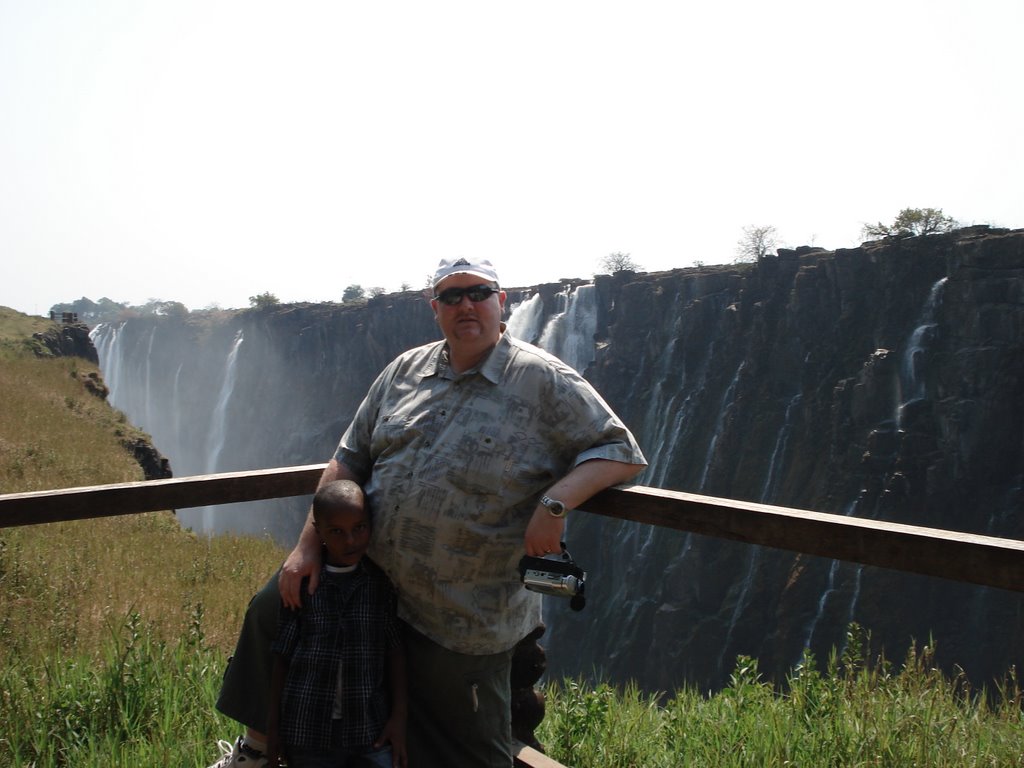
Here I am at the Falls! The picture is taken in August so the Falls are relatively dry! In the rainy season November-April the water fills to such an extent that needs to where a rain coat to avoid leaving the area soaked to skin.
From our vantage pointon the Zambian side of the Falls we could see a handful of tourists on the Zimbabwean side. When I first visited the Falls in 2002 the Zimbabwean side was packed and relatively few people viewed the Falls from Zambia. Times have changed. Livingstone has now firmly placed itself on the tourist map. This is fantastic for Zambia as tourism can bring much needed Forex in the country. (Whether the ordinary Zambian benefits from this is an argument for another day!) Livingstone has changed so much in the five years I have known her. The town is now full of lodges. Most of these are owned and run by Zambians. The large hotels and lodges, which are in closer proximity to the Falls area, are primarily owned by foreigners though. One cannot deny though that the Royal Livingstone Hotel and the Zambezi Sun are two of the finest hotels anywhere in the world.
Thursday, August 24, 2006
Our Zimbabwe dilemna
Three years ago whilst living in Francistown, Botswana I wasa regular visitor to Zimbabwe. Every other weekend my family and I would cross the border into Zims with groceries for our relatives. We did not cross the border exclusively to assist otehrs though; we crossed because we loved the warm welcome and happy atmosphere of Bulawayo. On our recent trip we didn't enter Zim. We received mixed advice about the wisdom of doing so. With the benefit of hindsight I think we should have have gone - to visit family but also to see for ourselves how things have changed. It was only the fear of harrassment from the police that detered me. I have always coped with it previously but this time I just felt I didn't have the patience to cope. The stories of people being strip searched at the border as official searched for illicit currency was off-putting as was stories of seven roadblocks between the Plumtree border post and Bulawayo. Next time I must bite the bullet though and cross the border...
Friday, April 28, 2006
The Zambian Alliance of Women & Home Based Care
All profits made through the charitable side of the Thembinkosi Foundation are shared between a number of organisations we are associated with in Zambia. Later we hope to venture into Zimbabwe, Botswana and South Africa but as for now we are a growing organisation and we know our limitations.
We are supporting the work of the Zambian Alliance of Women (ZAW). ZAW exists to promote the interests of women and children. It is committed to empowering women and does a wonderful job on a shoestring budget.
We are also supporting a number of 'Home Based Care' projects. Many Zambians carrying the HIV virus do not have access to treatment and certainly cannot afford hospital care. Home Based Care projects, often staffed by individuals who are HIV positve themselves, exist to support the weak and vulnerable in their own homes.
Wednesday, April 19, 2006
Back to Africa
I'm heading back to Africa for the first time in over a year this summer. I can't wait! My wife, son and I are flying into Jozie before heading up through Bots and in Zed. We may venture into Zims but that will depend on the 'situation.' I would like to see how things have changed in the three years since I was last there. I know it'll be heartwrenching and I'll hear dreadful stories about peopleI've known well. The trouble is that when we used to travel to Bulawayo regualrly we had a bakkie but this time we will be relying on buses and lifts from friends. If we do go the Bulawayo then we have to have maize meal, sugar, cooking oil, salt etc. The people need these commodoties more than anything.
Everywhere we go I will be armed with my camera. I want to take hundreds of pics to publish with the stories that go with them. One of my regrets about my time living in Bots is that I never took enough photos. I will take photos of development as well as poverty; of people happy and prosperous as well as poor and repressed. The negative images of Africa that the Western media peddles sicken me. Of course there is poverty, sickness and repression across the continent but this is the only image of Africa most Europeans/North Americans have. I love showing my students at school pictures of modern Johannesburg and asking them where in the world do they think this city might be? New York, Chicago, Rome or Berlin are common responses. When I tell them that it's Johannesburg in South Africa their jaws drop!
Everywhere we go I will be armed with my camera. I want to take hundreds of pics to publish with the stories that go with them. One of my regrets about my time living in Bots is that I never took enough photos. I will take photos of development as well as poverty; of people happy and prosperous as well as poor and repressed. The negative images of Africa that the Western media peddles sicken me. Of course there is poverty, sickness and repression across the continent but this is the only image of Africa most Europeans/North Americans have. I love showing my students at school pictures of modern Johannesburg and asking them where in the world do they think this city might be? New York, Chicago, Rome or Berlin are common responses. When I tell them that it's Johannesburg in South Africa their jaws drop!
Wednesday, November 30, 2005
How could anyone not know about HIV/AIDS?
The circumstances surrounding Jacob's death were upsetting. I was incredibly touched by his father's story. What shocked me more though was a conversation that took place shortly afterwards.
There were five of us sat around the fire. All men. I was considerably younger than the others though. I'm in my thirties at the time, whereas each of the others were at least fifty. The conversation started with one of the men saying ' I don't know what is happening to all our young people in this country. They are all dying.' I was stunned by his words. I knew all about the conspiracy of silence that surrounds HIV/AIDS but this did not seem like a man in denial. The other men nodded in agreement. None of them knew what was happening to their youngsters either. I wanted to scream at them 'They are dying of AIDS for God's sake!!!' but I said nothing.
These men were bright intelligent men. Leaders of their community. Well educated, articulate but...did they not know about HIV? How could they not know? Then again why would a man in his fifties know anything about HIV/AIDS? Where and with whom would he ever discuss it? No wonder these men could not guide their children. Did their grown up children, who certainly knew more of the risks of unprotected sex and promiscuity, need their guidance anyway? They certainly wouldn't have sort it.
I still don't know what to make of the conversation. I still genuinely believe that these men knew nothing of HIV/AIDS though. I don't know how anyone could not know about it but then again was I looking for the messages on the subject? I was. I listened to radio ads, read newspaper ads but I was always an outsider looking in. Did I ever have anything like the same perceptions as a Zimbabwean, Zambian or Motswana? I don't know...
Tuesday, November 29, 2005
Death without dignity in Zimbabawe
My friend's uncles story of his sons death was touching. As we sat around the fire he told me of his loss and his grief.
His son, Jacob, had been at the cattle post for about a week but had made his way back to the city due to his ill health. Apparently he had been ill several months earlier but had made a seemingly full recover (it's amazing how often I heard that at funerals!) Upon reaching home he could barely walk or talk so my uncle immediately drove him to the main hospital in Bulawayo.
His son, Jacob, had been at the cattle post for about a week but had made his way back to the city due to his ill health. Apparently he had been ill several months earlier but had made a seemingly full recover (it's amazing how often I heard that at funerals!) Upon reaching home he could barely walk or talk so my uncle immediately drove him to the main hospital in Bulawayo.
Jacob was obviously seriously ill and his father genuinely believed that the hospital would be able to help him. After all this was Zimbabwe - for so long the bread basket of Southern Africa. My friend's uncle knew only of a well resourced highly efficient hospital that served Bulawayo. He was broken hearted to find the hospital in a state of disrepair and filth. With no other option he checked Jacob into the ward. Jacob was taken for examination and was returned to the ward where his father awaited. He was then informed that unfortunately there was no medicine available and that all the hospital could do was place Jacob under observation.
My friend's uncle was obviously shocked but said he felt that at least the authorities would be able to look after his son. He then asked the nurses for blankets to cover his shaking and desperately ill son. He was told that there were no blankets available and that patients had to supply their own blankets. He immediately drove home to get blankets but could not fathom how it could be that a hospital could not provide a desperately sick man with something to cover himself. When he arrived back he did his best to keep his son warm until in the early hours of the next morning Jacob passed away.
Monday, November 28, 2005
The Bulawayo funeral house
It was my first visit to my friend's family place. I had expected a fairly modest dwelling but I found them living in a large farmhouse on the outskirts of Bulawayo. The house was somewhat rundown on the outside but was very well kept internally. The warmth of the welcome I received was overwhelming especially given the circumstances - they had just lost their son! I arrived on a Saturday afternoon. The family had just returned from their church service (as 7th Day Adventists they worship on Saturday.). It was daylight but there was a nip in the air so the warmth of the fire was welcome. The grounds of the house were immaculately kept. Vegetables were growing and elsewhere the lawn was neatly mowed. If I hadn't had known better I would have thought the family to be quite prosperous. In fact they were well off not long before but Mugabe's tyranny, especially against the Ndebele people in Matabeleland, had made their saving worthless. My friend's uncle worked as an inspector of schools. A good well paid job in normal times but like any other Zimbabweans, outside of the Presidents inner circle, the family were living from hand to mouth.
He is an inspirational man though. Despite the hardships he was suffering, the economic ruin and mostly the loss of his son he refused to be downhearted. His faith in God obviously sustained him and his family - although they had many questions they wanted to ask God!
He is an inspirational man though. Despite the hardships he was suffering, the economic ruin and mostly the loss of his son he refused to be downhearted. His faith in God obviously sustained him and his family - although they had many questions they wanted to ask God!
Thursday, November 24, 2005
Death and hardship in Zimbabwe
One day whilst I was living in Francistown I received a phone call to tell us that one of my friend's cousins had died in Bulawayo. The next weekend we crossed the border into Zimbabwe and headed to the house.
We crossed the border at Plumtree countless times. I'd often spend weekends in Bulawayo. Hotels were cheap. You'd change your Botswana Pula into Zim Dolars at the border and for what amounted to enough money for a few groceries in Botswana you could enjoy a great weekend in Bulawayo.
The border crossing was relatively painless. It was as frustrating at times but I was rarely harassed. To be fair the Zimbabwean officials treated me with great respect, despite my British passport, and I'd often face more needless bureaucracy when crossing back in to Bots - even with residence permits! On the odd occasion I had to pay tax on the groceries I was carrying. The tax was pittance but the delay caused by queuing to pay it was an unnecessary burden.
The groceries we carried were for people I knew in the Bulawayo area. Due to the ever worsening plight of the people of Zimbabwe it became increasing necessary for me to carry groceries including mealie meal, sugar, flour, cooking oil and salt every time I traveled. These commodities were unavailable in Bulawayo at that time.
After crossing the border one would pull over into a lay-by where one would instantly be surrounded by dozens of young lads offering varying exchange rates for Botswana Pula. After making the trip several times I got to know a few of the boys and I always used the same ones when changing money. That way one could be sure to avoid the special branch officers who allegedly infiltrated the money changers. I'd pick up one of our lads at the border and drive slowly to Plumtree village, a few KM's away. As I drove i would sort out the exchange of currency with the lad. The system worked well and was safe. After the deal was done we'd drop the lad off at Plumtree village so that he could make his way back to the border. Using the parallel market became a perfectly natural thing to do and literally everyone from Botswana travelling into Zims did the same.
Tuesday, November 08, 2005
No fear!
In fact most of the guys I got to know in Botswana worried very little about catching HIV. Now I'm not talking about illiterate guys who knew nothing about the virus or saw it as some form of curse. I'm talking about educated guys who knew exactly how the virus is transmitted but still had little or no fear of it. I'm talking of Batswana friends of mine, Zimbabwean friends, Zambian friends and friends from the UK and Irealnd.
Before I lived in Botswana I assumed that anyone who knew anything about HIV/AIDS would avoid unprotected sex. Of course they would. Afterall it's a potentially fatal virus. It kills you and people want to avoid death at all costs. Certainly that is the attitude I had when I went to live in Botswana. That attitude was to change the longer I lived in Botswana. I didn't actually indulge in risky behaviour myself but I began to understand the mindset of those who did. Some of their stories I will tell in forthcoming posts...
Before I lived in Botswana I assumed that anyone who knew anything about HIV/AIDS would avoid unprotected sex. Of course they would. Afterall it's a potentially fatal virus. It kills you and people want to avoid death at all costs. Certainly that is the attitude I had when I went to live in Botswana. That attitude was to change the longer I lived in Botswana. I didn't actually indulge in risky behaviour myself but I began to understand the mindset of those who did. Some of their stories I will tell in forthcoming posts...
Subscribe to:
Posts (Atom)

 Posts


