Showing posts with label Zambezi. Show all posts

Saturday, July 30, 2011

Zambezi International Green School - Opening Soon!!!

Great news from Zambia! We are close to opening the first phase of our green school here in Zambia. In order to kick start the project we have agreed to rent a building in Livingstone where we are going to open a per-school and nursery section. We have been working with various partners over the past few weeks and things are looking good right now!

Of course our aim is to build our own school on the banks of the Zambezi and we also have good news on that front. After much delay we are now (hopefully) near to securing the title deeds for the land. This is a vital aspect of our project - Madonna's schools project in Malawi collapsed as she failed to gain land rights! All being well we will be opening our secondary section in Sept 2012/Jan 2013 on the banks of the mighty Zambezi River!

Right now we are looking for volunteers to work with us on various aspects of the project. Firstly we are looking for Early Years Learning/ Pre School teachers to work with us at our ZIGS, Livingstone. Qualified teachers looking for a fresh challenge or anyone who fancies a gap year or internship should get in touch. We are not in a postion to pay more than an allowance but can offer the chance to work for a project that will really make a difference in children's lives!

For our purpose built secondary school we seek an archetect with genuine green credentials to work with us in designing the school. It is an exciting opportunity as we can offer the right person a carte blanche in the resepct of design in a genuine wilderness setting. If you know such a person ask them to contact us!!!

Soon we will be recruiting teachers and an array of support staff for ZIGS. Please consider what you might be able to do to help us with this amazing project or pass on this e mail to friends!!!

Thanks for all your support!!!

Contact us through Facebook or thembinkosifoundation@live.co.uk

Phone: 00260 973312390 (Adrian) 00260 978626719 (Betty)

Friday, September 18, 2009

Adrian's Tour de Zambezi

On the 15th August 2009, I, Adrian Scarlett with several Zambian family members, embarked on a 300 mile sponsored cycle ride across four countries in Southern Africa. We set out from Livingstone in Zambia and then spent the three days cycling through Zimbabwe, Botswana and Namibia before returning to Zambia and cycling back to Livingstone. The trip involved six days of cycling.

The Liverpool Echo featured us, and the charity we founded, the Thembinkosi Foundation, on 3rd July 2009, after I was assaulted whilst training for the Tour de Zambezi. As a result of my injuries my training was interrupted for a month but my strength of character and willingness to succeed in the face of adversity saw me recommence my training regime and ensure that the sponsored cycle ride was done.

I did not cycle alone. I was joined in completing his trip by his brother in law, Fungai Madondo and DJ, a cousin of my beautiful wife Betty. Two of our 15 year old nephews, Nawa and Kaone, also cycled a fair proportion of the challenge and our son, Bongani also joined in the fun. Bongani was a real star cycling up to 15 miles on two of the days in the intense heat!

The cycle ride began at the site of the Victoria Falls. We, the intrepid cyclists, began the Tour de Zambezi by crossing over the Zambezi River and entering into Zimbabwe. Once at Victoria Falls town we were met by two armed Game Wardens who remained with us as we cycled through a Game Park that is heavily populated with elephants, giraffes, zebra and lions! The first day was arduous. The terrain was undulating and the heat of the African sun sapped our energy. The scenery was breathtaking however and after six hours we reached the Kazungula border crossing and entered into Botswana. Our whole party, which also consisted of my wife Betty Scarlett, her sister Constance, brother Jabulani and Auntie Irene, then camped overnight in Kasane.

The following morning saw us venture into the Chobe National Park and cycle to Ngoma and the Namibian border. In normal circumstance cycling is not permitted in Chobe due to the fact that it is densely populated with game. However, the Botswana Wildlife officials granted us a dispensation and allowed us to cycle through the park. Rather worryingly they were unable to provide us with Game Wardens to protect us from the wild animals. As a result only three of us cycled through Chobe. Those of the party under 16 had to ride in the support vehicles. The Chobe leg was in many ways the most exciting especially when we encountered a herd of elephants on the road. Fortunately the elephants were busy going about their business and left us alone!

The third day saw us cycle through Namibia from Ngoma to Katima Mulilo. Thankfully the terrain was flat and there were no wild animals to be avoided. The day was brightened by the reception we received as we passed through many small villages on route. Children cheered us on and some local cyclists joined us for parts of our journey. Once in Katima Mulilo we spent a rest day at a very relaxing camp site!

The next three days of cycling saw us gradually cycle the 150 miles through Zambia back to Livingstone. Again our journey was brightened by the children in the villages. The last day proved to be the most difficult. Fatigue had taken its toll and once again we encountered many hills. We stuck it out though and dug deep into our energy reserves. When cycling through Kazungula district we stopped for drinks in a small village and spent some time chatting and dancing with some of the locals. Eventually on the afternoon of 21st August we arrived back in Livingstone. The final 10 miles were a joy as we approached the Falls to complete our circuit.

The Zambia National Broadcasting Corporation met us for the final stages of our journey and that night we were featured on the early evening national news. They even interviewed me!

One of the great features of our sponsored ride was the fact that one of the bikes that we took it in turns to ride was made from bamboo. The bamboo is grown and harvested in Zambia and the bikes are assembled by local employees. Zambikes, who lent us the bamboo bike, as well as two other bikes, shares a commitment to sustainable development with the organisation we were cycling on behalf of, the Thembinkosi Foundation.

All the cyclists and supporters who took part in the Tour de Zambezi wore tee shirts sporting the Rotary International logo. One of the most memorable moments during the Tour de Zambezi was when we stopped in Kazungula and spent time with some of the local people who will benefit from the building of a school in their district and from a range of outreach programmes that will see water, sanitation, electricity and better health care for many in the district.

Please support us by supporting us financially in any way you can!

Acc Name: Thembinkosi Foundation
Bank: Barclay bank
Acc # 63226387
Sort Code: 205094

Registered Charity Number: 1128661

Wednesday, May 13, 2009

My recent trip to Zambia

I recently spent two weeks in Zambia over the Easter holidays. The trip was incredibly fruitful and it is certainly true to say that we are a step nearer to fulfilling our dream.

Whilst in Zambia I was priviledged to visit the Kasisi Agricultural College. The agricultural college is part of a wider facility run by the Jesuits which includes a girls secondary school and an orphanage. It truly inspirational place. The agricultural college focuses its attention on organic farming and sustainable development and is a model of what we want to achieve at our school. The main difference being that the college focuses on adult education whereas we will focus upon the education of the young. (although our outreach projects will enable aspects of adult education.) The great news is that the people at Kasisi are willing to provide us with the necessary training and support to ensure that we can emulate their work on the banks of the Zambezi.

I am returning to Zambia in July and I will be spending the entire summer holiday working on developing our school. We are still confident that we can be ready to open in September 2010 but in order to do so we need to step up our fundraising efforts! There are a few 'fires in the oven' at the moment so hopefully ove the coming months we can boost our coffers and then commence building. We will of course be building the school with local materials that are freely available in the locality of the school which will of course minimise the cost of the project. That's the beauty of sustainable development - it makes economic sense as well as environmental sense!

Finally a big thank you to Laura and friends who are climbing Ben Nevis next month in order to rasie funds for the Thembinkosi Foundation and our project to build and sustain a school in Zambia. You can sponsor them in their efforts by visiting our Just Giving page http://www.justgiving.com/thembi... Once again thanks for all your support. It is hugely appreciated!

Tuesday, May 12, 2009

The effective utilisation of water

Our proximity to the river will also ensure that we have a source of water. The Zambezi is a fresh water river and thus drinking water is readily available. Unfortunately at this time many villagers on the shores of the river have to run the gauntlet of crocodiles and hippopotamus’ in order to collect water. It is our aim at ZIGS to provide drinking water for our neighbours as well as our own community. We envisage the use of a combination of sand dams and sub surface dams both of which can be built using local labour and materials and thus prove to be cost effective. These dams are especially cost effective as once constructed they require very little maintenance and produce a high yield of water.

Furthermore, we will also seek to harvest and store rain water on our campus. Given our proximity to the Zambezi this is a necessity but as part of our model of sustainability we wish to demonstrate that peoples do not have to be dependent on bore holes and/or wells for their water as more than enough rain water falls within Zambia, and across Africa, on an annual basis for peoples to be able to harvest and store water during the rainy season, for use in the dry season. In order to demonstrate the principles of water harvesting in order to be a model for other communities we will roof some of our building with treated corrugated iron sheets. This will allow for a run of f of water that can be channelled into underground covered tanks for use across the year. Most water in this part of the world is lost to evaporation so hence the need for covered tanks. Again this is a relatively low cost method of collecting water as low cost materials are used in the construction of the storage tanks and catchment surfaces.

For more details on water harvesting and storage visit the wateraid website.

For more specific and detailed information on Water Harvesting.

Of course waste disposal will also be a priority at ZIGS. We will seek to recycle water and to utilise grey water in line with the ‘Earthship’ model that is popular within the ‘green community.’ Furthermore, we will seek to use modern eco friendly waste disposal technology in order to preserve our model of sustainability.

All of our buildings at ZIGS will be built from local materials and by local tradesmen. We will ensure that materials that have to be transported by road to our site are keep to an absolute minimum. The area is awash with timber (we will of course plant ten trees for every one we use in building) and stones cover the landscape. Naturally enough these will be the core materials with which we build! Of course we will have to go outside of the community for some materials such as glass but we will seek to minimise the distance that raw materials have to travel in order to reach our site.

Sunday, May 03, 2009

Sustainable development and renewable energies

Another core feature of ZIGS is our commitment to sustainable development and to living at one with the natural world. From the outset we have planned the building of ZIGS to embrace these principles. The site on which the school is to be built is on the banks of the Zambezi. It is our aim to utilise the water from the river to generate hydro electric power. This method of generating electricity is totally sustainable, clean and renewable. As well as providing power for our own campus we expect to produce a surplus of power which will be partly used to provide local communities with electricity! The use of renewable energy is not only eminently sensible from an environmental perspective it is also economically sustainable and will ensure that ZIGS has no bills for electricity!

A very detailed and technical description of small scale hydroelectricity available by following the link!

Not only will we use hydroelectric power but we will also use solar energy. Solar panels will be used to provide power in the more remote outposts of our campus. Like hydroelectric power solar energy is renewable and green.

Tuesday, March 10, 2009

Sunset over a Zambian Fishing Village


The extraordinary thing about Ngwanzi village is that the villagers do not have any access to running water. The women and children have the duty of fetching water from the river as and when it is required. This task is not only onerous and backbreaking but is incredibly dangerous. Crocodiles lurk in the water and on the river banks and the simple task of fetching water can be a life threatening pursuit. This may sound over dramatic but only last month one of the elderly villagers in the village  was eaten by a crocodile.

Moreover although the life of a fisherman may look idyllic for a young man it is also a life fraught with danger. A young fisherman, and many of them are very young, will face the perils of life on the river. Hippos, as you may know, are responsible for the deaths of more people than any other animal in Africa (besides humans!) and the hippos lurk in the waters of the Zambezi. Get between a hippo and her young and your life is on the line.

Besides these dangers there is the ever present danger of malaria - Africa's biggest killer. The village lacks any form of health care facility. There is not even a simple clinic.

The people of Ngwanzi village may life a happy life for the most part but there is no doubt that access to running water, basic sanitation, electricity, basic health care and education for their children would dramatically improve their lives. The Thembinksi Foundation hopes to make a difference in the lives of these people. By providing education for children and adults, providing access to running water, basic sanitation and health care we hope to make a difference to children like the one's we met in Ngwanzi.

Monday, March 09, 2009

In search of Chief Sekute and the death of a President

On 19th August 2008 President Levy Mwanawasa passed away. I heard the news of his death in Ngwanzi village which is on the shores of the River Zambezi in the Kazangula District of Zambia.

We had spent a whole day travelling throughout the Kazangula District in search of Chief Sekute. The Chief was travelling from village to village in his Chiefdom visiting his subjects but he had agreed to give us an audience provided that we could find him! We were travelling with two of his nephews, but as our mobile phone signal only worked in certain areas out in the Bush we were finding it very difficult to actually find him.

Eventually, almost as the sun was setting, we found out that the Chief would shortly be arriving in Ngwanze. We made our way to the quaint fishing village and awaited his arrival. Whilst waiting we were shown around by the Headman. The village was a hub of excitement. It was a time of great anticipation awaiting the Chief's arrival. As we waited we heard the Zambian National Anthem being played on a distant radio. At the time this didn't seem unusual but with the benefit of hindsight we realised the significance of this event. Nearby to where we had parked our hired 4x4 vehicle we huddled around a small radio, that barely picked up a signal, and heard the news that the President had died.

People had long speculated over the health of the President and some had quietly speculated that they suspected he would never return to Zambia from his hospital in Paris. Logic dictated that this was a reasonable hypothesis. However, there was always hope. Hope had ended with this radio broadcast though and now all had fallen silent.

Soon Chief Sekute arrived, but to a much different atmosphere to the one of only an hour earlier. Upon his arrival he made his way to the centre of the village to be greeted by the senior villagers. The mood was sombre as Betty and Constance made their way to pass on our condolences to the Chief. We had sort out the Chief in order to discuss the possibility of acquiring land in his Chiefdom but now our trip had taken on a new perspective.

President Levy Patrick Mwanawasa was an honest, decent and humble man who sort the best for his people. He fought corruption in Zambia and upheld the rule of law and the principles of democracy. He is sadly missed by the people of Zambia and by many others in Africa. May he rest in peace.

Sunday, March 08, 2009

Monthly Update March 2009

Thank you so much to those of you who have joined our cause or one of our groups on Facebook and for helping us in our project to build and sustain a school in Zambia. Please keep on inviting (and reminding) all your friends to join so that our 'cause' continues to go from strength to strength.

Breaking News: I will be travelling to Zambia during the Easter holidays. During my trip I will be working hard to ensure that we can start building our school in the near future. We have thus far secured a prime piece of land on which to build our school on the banks of the Zambezi and we potentially may have secured additional land on which to develop aspects of our outreach and community projects. We are very grateful to Constance who is working so hard on our behalf in Zambia.

Breaking News: We have been in regular touch with the Charity Commission and fingers crossed we should be a registered charity within the next week or so. Gaining the status of a registered charity will open up several additional channels of funding so the sooner we are offiicially recognised as a charity the better!

Breaking News: You can follow the progress of our project through Twitter www.twitter.com/thembinkosi

We will be back in touch as soon as we have anymore significant news to report. In the meantime please feel free to utilise our discussion boards, sign our guestbook on our website, add us on twitter and plurk and keep spreading the news about our project by inviting everyone you've ever met to do the same.

Saturday, March 07, 2009

Eathship Living and Sustainable Development

As part of our commitment to the principles of sustainable development the Zambezi International Green School will include many of the principles of Earthship Living. Unlike the Earthships shown in the video we will not be using tyres in the building of our school (as waste tyres are not readily available in the African Bush!) but we will be utilising whatever we can recycle in our natural environment. Furthermore, we intend to adopt many of the principles of Earthship Living. We will harvest and recycle our own water, partly from rain water and partly from the nearby river, and we are committed to generating all of our own energy without any recourse to fossil fuels. In fact most of our power will be generated through the use of water with perhaps some solar energy where necessary. The reason for this is primarily that through the effective use of water we can be 86% efficient in generating power compared to the approximate 16% efficiency of solar panels!

Sunday, January 11, 2009

Building a school in Zambia - we've secured land!

Things are moving on apace in Zambia in regard to our project to build and sustain a school. Constance has had several meeting with the Chief and his Headmen and reached an arrangement whereby we will be given 30 hectares of land, on the banks of the Zambezi, on which to build the Zambezi International School. All of us involved in the Thembinkosi Foundation are understandably delighted!

We first approached the Chief about the possibility of acquiring land in his Chiefdom, for the purpose of building a school, in August. Our progress was somewhat hindered by the untimely death of President Levy Patrick Mwanawasa and then by the subsequent Presidential by election but throughout this time remained in regular contact with the Chief . He has been very enthusiastic toward our project ever since we first approached him. He shares our vision of empowering his people and he is convinced that our project will be of great benefit to his subjects.

During our negotiations with the Chief and his Headmen it became increasingly apparent that our project has the potential to make a real difference to the lives of the people within the surrounding district. The land that we have been given is adjacent to a village which has its place on the banks of the river. The villagers live simply - sustaining themselves through fishing and by exchanging their surplus for mealie meal. The village lacks any form of infrastructure and the people are not only some of the poorest in Zambia but are among the poorest in the world. The Headman of the village sees the potential benefits to his people that will come through the building of our school adjacent to the village.

ZIS will of course be a fee paying institution. This is to ensure the financial sustainability of the project. However, part of the raison d’être of our project is the empowerment not only of the students who attend ZIS, but also the empowerment of the community of which we will be a part. In the first instance we have promised the community that we will provide electricity and running water to the villagers and subsequently we will bring the gift of education to the children of the village through our supporting of the building and sustaining of a local village school. Not only will we support the building of the village school but we will also share the facilities of ZIS with our neighbours. Thus as ZIS grows and develops the communities we are working with develop. And this development is multifaceted. The development will be tangible in terms of the infrastructure, water, electricity and roads but will also bring about employment opportunities for the villagers. Furthermore, as part of our commitment to our Outreach Projects our teachers, and older students, at ZIS will work with the children at the village school and beyond.

We envisage being a self sufficient institution within three to five years of opening our doors to our first student. Beyond this stage we would hope that any fundraising will be done with the aim of supporting our outreach projects rather than contributing to the sustaining of the school. By this stage we would also hope to have develop our land in order to have cultivated our land and introduced livestock in order to ensure that ZIS becomes a self sufficient institution. Now that we have land on which to build we are along way to fulfilling our dreams but there is still along way to go. The next stage of the project involves the legal process of the transfer of the land rights from the Chief to ZIS and then the employing surveyors and architects to plan for the physical aspects of the school.

The success of the project to date would not be possible without all the people who have supported us thus far. Everyone who has offered us words of encouragement, kept our project in their prayers, joined our Facebook group or visited our website has kept us going. When we reflect on the scale of the project we have undertaken and the difference that we have the potential to make it can sometimes be overwhelming but knowing that we have so many people who believe in what we are doing is so inspiring.

Sunday, January 04, 2009

Monthly Update - January 2009

Happy New Year! I hope you had a wonderful Christmas and that 2009 brings you great happiness. Thank you for supporting the Thembinkosi Foundation and our project to Build a school in Africa. The project has really taken off over the past few month.... but there is so much more to do....

We have now registered our charity with the Charity Commission and as a result we will shortly be an official charity! We're just waiting on being awarded a 'charity number.' Once we have this status it should give our fundraising a real boost - especially as we'll be able to get tax relief on all donations that we receive!

Meanwhile things have been moving along nicely in Zambia. Constance, the driving force behind the project in Zambia, has had several meetings with the powers that be in the Kazagula District and as a result we have been promised a large piece of land on the banks of the Zambezi.

We would like to contine to spread the gospel about our project and reach over 1000 members of our Facebook group in the next few months. We need your help to do this.....Please would you also invite all your friends to join our Facebook group - it will only take you a few moments to do so. You might also tell your classmates/workmates about this project? Perhaps your school/company might be able to support the Thembinkosi Foundation during 2009?

Please contact any of the group admins if you have any questions about our project or ideas on how to raise funds. We are always delighted to hear from people who share in our passion for empowering young people in Zambia through this project.

We really want to help bring about a real change in Zambia and with your help we can do so...

Thank you so much....

Sunday, November 09, 2008

Sustainable development, bio-diversity and environmental awareness in Zambia

Humankind has a duty to analyse and act upon environmental issues. The generations of the future have to be environmentally aware if we are to survive. It is vital that concepts such as sustainable development, bio-diversity and how to achieve environmental awareness whilst retaining a sense of environmental integrity are grasped. The Zambezi International School will be a truly unique, co-educational institution, based on the banks of the Zambezi River in the heart of the most important safari area in the whole of Southern Africa


ZIS will see the birth of a revolutionary educational ethos; through the medium of the natural environment, pupils can be exposed to issues of multiculturalism and the challenges of the environment itself, where they test themselves in a different context within a variety of appropriate activities so promoting a deeper understanding of themselves and the world around them.


ZIS will be the first school of its type in Southern Africa and possibly the world. A school with an environmental philosophy, a thirst for social justice and a determination to make a difference. Based in the Kazangula District of Southern Province on the shores of the mighty Zambezi River, with a strong commitment towards community upliftment, outreach projects and the empowerment of local people.

Thursday, September 25, 2008

The unique nature of ZIS

The Thembinkosi Foundation exists to build and sustain Co-educational school in Sub Saharan Africa. We are not the only organisation committed to the building of schools in the region but we are one of a few organisations committed to ensuring the sustainability of the schools we build. We aim to ensure that our project is self sufficient and sustainable through:
The building and running of our own schools. This ensures that the fruits our work is not squandered by corrupt government or local officials, as is sadly so often the case in the developing world. We at Thembinkosi Foundation ensure that our employees are accountable for the quality of education that they provide and that sustainable support is provided to our staff.
The charging of fees for the majority of students attending ZIS. This should ensure financial sustainabilty within the first three years of operation. Evidence suggests that private schooling not only benefits the middle classes in the developing world but benefit all.
Private schools to benefit the poor
Ensuring that day to day self sufficient nature of our community through the keeping of animals, the growing of crops, the use of sustainable bio fuels and the use of solar and micro hydro electric power. ZIS will be built on the banks of the Zambezi thus ensuring a sustainable source of water for our agricultural projects.

Thursday, September 18, 2008

Thembinkosi Foundation - The Website

Today saw the birth of www.thembinkosifoundation.com. This is a particularly exciting development for us as it's another step on the way to turning a vision into reality. I'm also personally quite proud of myself as I built the website myself! No great shakes to many I'm sure but it's an achievement that I am proud of! It is rather basic but contains most of the importnat information about our plans to build and sustain a school/schools in Zambia and to provide outreach projects in the wider community we will serve.

Monday, September 15, 2008

Zambezi International School

Thembinkosi Foundation has been developed and has taken on an added dimension. It is no longer merely a blog about my experiences of living and working in Botswana and Zambia and my thoughts about life and religion in Sub Saharan Africa. Thembinkosi Foundation now has a mission to bring high quality education to Zambia. The Thembinkosi Foundation will seek to raise the required funds to build and sustain the Zambezi International School on the shores of the Zambezi River in the Kazangula District of Southern Province, Zambia. The project we invisage is tremendously exciting and we are sure can have a real impact in developing and sustaining education across the region.

Tuesday, September 19, 2006

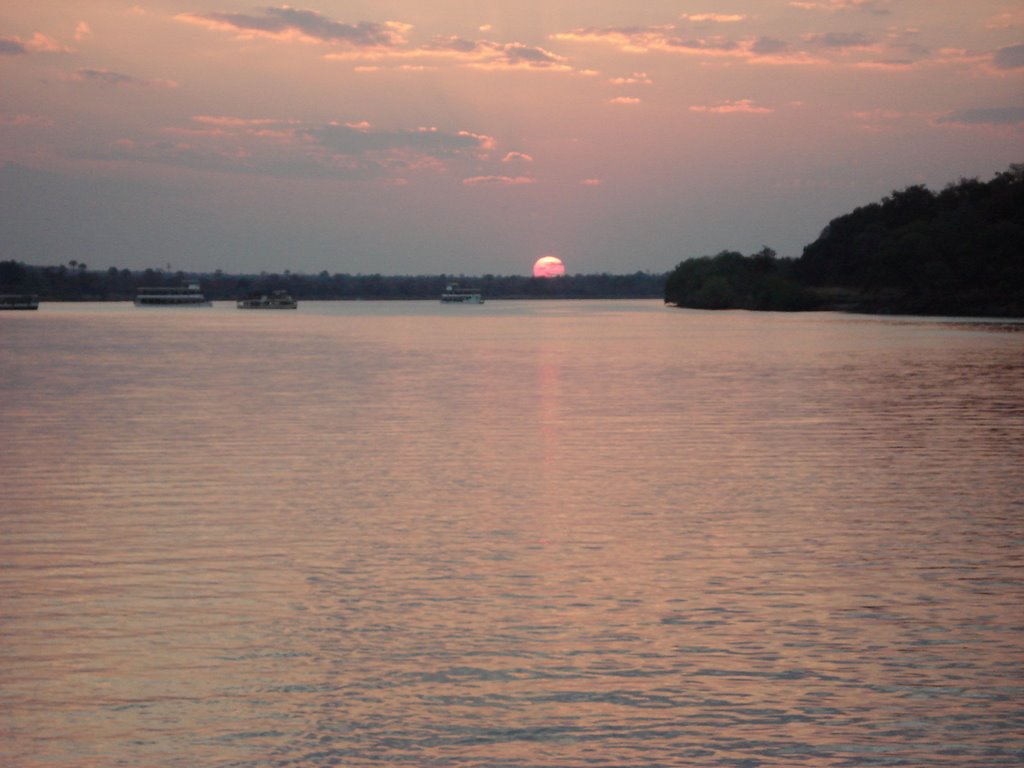
Sunset on the Zambezi


The natural beauty of Zambia is incredible. This picture was taken from a boat upon the mighty river. The boats in the distance are full of tourists admiring one of the world's most beautiful sunsets.

Saturday, September 16, 2006

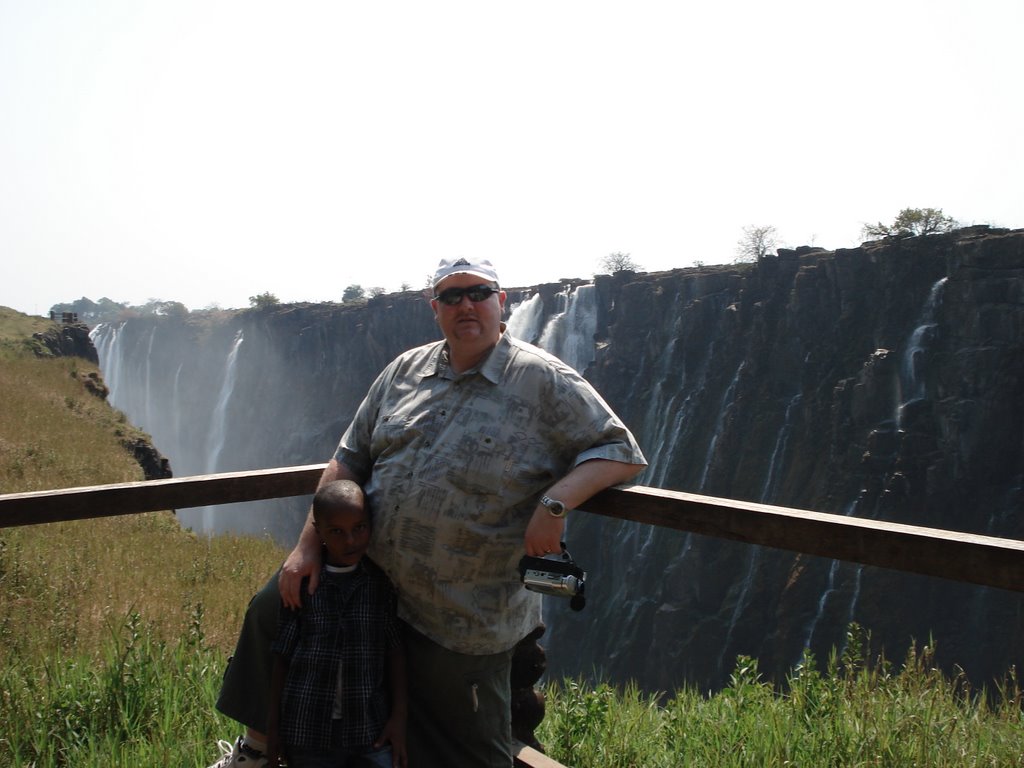
An experience of wonder and awe!!!


Here I am at the Falls! The picture is taken in August so the Falls are relatively dry! In the rainy season November-April the water fills to such an extent that needs to where a rain coat to avoid leaving the area soaked to skin.

From our vantage pointon the Zambian side of the Falls we could see a handful of tourists on the Zimbabwean side. When I first visited the Falls in 2002 the Zimbabwean side was packed and relatively few people viewed the Falls from Zambia. Times have changed. Livingstone has now firmly placed itself on the tourist map. This is fantastic for Zambia as tourism can bring much needed Forex in the country. (Whether the ordinary Zambian benefits from this is an argument for another day!) Livingstone has changed so much in the five years I have known her. The town is now full of lodges. Most of these are owned and run by Zambians. The large hotels and lodges, which are in closer proximity to the Falls area, are primarily owned by foreigners though. One cannot deny though that the Royal Livingstone Hotel and the Zambezi Sun are two of the finest hotels anywhere in the world.

Monday, September 11, 2006

How free is education in Zambia?

I rememer recently watching Question Time on BBC1. One member of the Government waxed lyrically about the fact that education in Zambia is now free but how free is free education in Zambia I asked myself? Ironically that's the provocative title of a report released last week looking at the cost of education in Lusaka.

Looking at the results of this report prepared by the Jesuit Centre for Theological Reflection (JCTR), the Director Peter Henriot declared that he was saddened by the apparent absence from current political debates of intelligent discussion of serious questions like those raised about the quality and quantity of education for the youth of Zambia.

The Government of the Republic of Zambia made an important decision in 2002 to remove the so-called user fees in primary schools throughout the country.
The return of free education meant a noteworthy reversal of the IMF/World Bank designed cost sharing plans that were part of the overall Structural Adjustment Programme that Zambia was obliged to accept as a condition for debt relief.
Many people - parents, educationists and development advocates - hailed the move as a step in the right direction.
The introduction of school fees had brought a marked decline in the quantity of education and had not brought a significant increase in the quality of education.
The State House website says very clearly: The development of any nation depends on the quality of education that is provided for the children and the youths in the country.
It therefore promises that the government has realised the need to continue to invest in the education sector. President Mwanawasa has even indicated the desire to extend free education through Grade 12, assuring that no child is hindered from obtaining an education because of fees.

But the findings of the JCTR report point to issues that must be addressed before acclaiming that education in primary schools is truly free and is accomplishing the greatly desired steps toward development.

These issues definitely affect the availability of education for children from poorer families.
Although the report focused mainly on primary schools in Lusaka, it presents insights that point to a prevailing situation across the nation, across all types and levels of schools.
Any woman or man campaigning for the office of President, member of parliament or local councilor could get a sense of what the JCTR report concludes by simply walking around the compounds of Lusaka or other major cities or into rural areas.
Just talk with parents, teachers, and headmasters about the cost, accessibility and quality of education in Zambia, as did the two JCTR researchers, Chris Petrauskis and Sheila Nkunika.
Peter Henriot claims that if these candidates come up with different findings, they must be interviewing on a different planet! When we talk about costs of education, we must distinguish direct costs and indirect costs.
Direct costs are those administered by the schools, such as user fees, PTA charges or project fees. Indirect costs include school uniforms and shoes, books and supplies, transportation, private tuition, packed lunches, etc.
The JCTR report finds that the government policy of free education has led to the removal of nearly all direct fees for grades 1 to 7. But it is true that some schools continue, contrary to guidelines from the Ministry of Education, to administer modest (K10,000 to K30,000/year) PTA charges or project fees.
But it is indirect costs (mostly uniforms and shoes, books and supplies) that can add up to an average annual amount of K440,000 for one child.
What that can mean for poorer households of four to six children is, obviously, prohibitive of access to ìfree education. And to speak of extending free education up through Grade 12 without seriously addressing this problem is neither economically realistic nor politically responsible.

It is true that with the abolition of school fees the net attendance rate at primary levels increased from 71% in 2000 to 85% in 2004 - a commendable achievement.
But approximately 15% of Zambian children, almost 300,000 girls and boys between the ages of 7 and 13 - are simply out of the educational system, missing training in the basic literacy, numeracy and reasoning that is essential for their own and the nation's full human development.
The JCTR report found that in households located in high-density areas in Lusaka, many children simply were not in school. Some parents reported as many as 5 school age children out of school.

The majority of parents attributed the absence of their children from education to a lack of school fees.

Many sad stories told the human side of these statistics, especially for the girl-child for whom education in a school is considered by many as a luxury.

Zambia has signed on to the Universal Declaration of Human Rights, the Education for All action plan and the Millennium Development Goals all of which call for the realisation of universal primary education.

Petrauskis and Nkunika make the necessary recommendation, therefore, that some very positive action must be taken to deal with the indirect costs of education that are so burdensome to poor families, even as direct costs may have been eliminated or lessened.

An expansion by the Ministry of Education of its bursary programme is called for to ensure that poor or vulnerable households have access to sufficient resources to provide uniforms, transportation, lunches, etc.

Another recommendation of the report is that the Ministry of Education should assure that the guidelines are strictly enforced so that no child is sent away from primary education on account of being unable to pay any fee (whether Project or PTA) or not having a school uniform.
But this will also require that the Ministry of Education should allocate proportionately higher grants to schools serving poorer communities, so that the necessary funds can be available for recurring operation expenses and rehabilitative projects.

An obvious need to be met in order to advance both the accessibility and quality of education in Zambia is the improvement of conditions of service of teachers.
Surely teachers should be able to meet the demands of the JCTR Basic Needs Basket if we are to expect them to give their best in educating children.

Yes, education is costly, even free education! And so donors should be called upon for greater assistance to Zambia and the government should be expected to have better priorities in its expenditures and in its Fifth National Development Plan (FNDP)

Without well educated Zambians, foreign investors are not going to come to Zambia, whether or not they are welcomed by aspiring presidential candidates. HIV/AIDS rates are not going to decline significantly.

Local industry is not going to flourish and employment rates are not going to go up.
And Zambia's most important resource, our people will continue to be underutilised, underdeveloped and undervalued. Let's hear the political campaigners talk about that!